Funny Cat: A Designer’s Real-World Embroidery Review
First Impressions: Charm That Lands—Not Just Cuteness for Cuteness’ Sake
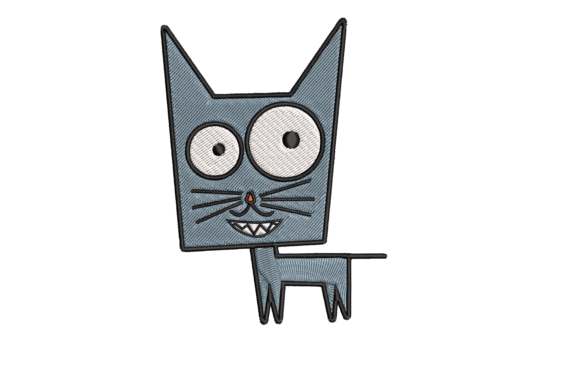
When I opened the Funny Cat embroidery file, what struck me wasn’t just “it’s a cat”—it was how the pose, expression, and line weight work together to create genuine personality. There’s a slight tilt to the head, one ear perked higher than the other, and a subtle smirk that reads as playful—not saccharine. It doesn’t rely on oversized eyes or cartoonish exaggeration. Instead, it uses clean silhouette balance and intentional negative space to hold visual interest at 3–4 inches wide—the sweet spot for tote bags, sweatshirt fronts, and baby onesies. As a designer who’s stitched hundreds of cat-themed pieces, I can say this: Funny Cat avoids the trap of looking “designed for screen, not stitch.” Its contours translate well to satin stitch edges, and its internal details (like whisker lines and paw definition) are spaced generously—not so fine they’ll vanish in fill stitch or blur on textured fabric.
Where It Shines: Real Projects, Real Customers
I tested Funny Cat on three real items: a medium-weight cotton canvas tote, a midweight fleece-lined sweatshirt, and a 100% cotton tea towel. On the tote, it held crispness without stiffness—no puckering, even around the curved cheek contour. On the sweatshirt, I used a light cutaway + tear-away combo stabilizer, and the design stayed flat and legible after washing (yes, I washed it—twice). The tea towel result surprised me: the whiskers and tail tip remained distinct, thanks to smart stitch density—not too sparse to look thin, not so dense it overwhelmed the fabric’s drape.
This is where Funny Cat earns its keep for craft businesses. It reads instantly at arm’s length (great for boutique shelf appeal), scales cleanly down to 2.75” for baby caps or up to 5.5” for pillow covers, and lands with warmth—not irony. Etsy sellers will appreciate that customers don’t need context to “get it.” A shopper sees Funny Cat on a holiday apron and immediately imagines gifting it to their cat-obsessed aunt. No explanation needed. That kind of intuitive recognition builds trust—and repeat orders.
Where to Pause: Practical Limits You’ll Feel at the Hoop
Funny Cat isn’t built for micro-hoops under 4×4". The tail curl and facial details shrink into ambiguity below 2.5”, and the inner ear shape starts to lose definition. If you’re stitching on thin jersey or stretchy bamboo knits, reinforce with a lightweight fusible stabilizer *before* hooping—this design’s gentle curves respond poorly to fabric movement mid-stitch. On dark fabrics, avoid pale thread for the whiskers; they’ll disappear unless you use a high-contrast color like charcoal gray or navy. And skip it for heavily textured surfaces like bouclé or thick terry cloth—the satin stitch areas won’t lie flat, and the charm gets lost in the fuzz.
Also worth noting: while Funny Cat works beautifully as a standalone machine embroidery design, it’s not structured as an applique design. Don’t try to swap out the body shape for fabric pieces—it’s digitized as a continuous fill-and-outline layout. That’s a strength for consistency, but a limitation if you’re planning layered texture.
Design Notes Every Embroiderer Should Check Before Stitching
- Test first on scrap fabric—especially if using non-standard thread weights or blending filaments.
- Review stitch density in your embroidery software. Look for tight clusters near the eyes or mouth—these can cause thread breaks on older machines.
- Confirm hoop size compatibility. Most versions fit comfortably in a 5×7", but verify before batching orders.
- Inspect small details at actual stitch size: zoom in on the tail tip and paw pads in your viewer. Do they read clearly—or collapse into noise?
- Mock it up in black and white before finalizing thread colors. Contrast matters more than hue for legibility.
- Compare light vs. dark backgrounds using printable mockups—what reads on ivory linen may vanish on heather gray.
- Use proper stabilizer: light cutaway for knits, tear-away for stable wovens, and avoid heavy mesh on delicate baby items.
- Check licensing before selling finished products or bundling Funny Cat into digital embroidery kits. Commercial use rights aren’t automatic—even for “personal use” files.
Why It Works for Your Craft Business—Beyond the Stitch
Funny Cat doesn’t just decorate—it communicates. When sewn onto a handmade apron sold at a local market, it signals approachability and craftsmanship. When stitched onto a personalized gift for a new pet parent, it feels intentional—not generic. That subtlety elevates perceived value. Customers pay more for pieces that feel *designed*, not downloaded. And because the expression reads across age groups—young kids giggle, adults smile knowingly—it performs well in mixed-audience settings: nursery decor, teacher gifts, vet office waiting rooms, even wedding favors for cat-loving couples.
For Etsy sellers, Funny Cat is low-risk, high-return design equity. It pairs easily with neutral palettes (cream, slate, oat), supports cohesive shop branding, and photographs well in natural light—no heavy editing needed. As a digital embroidery file, it’s versatile enough to anchor a seasonal collection (think: “Funny Cat & Pumpkin” for fall, “Funny Cat in Scarf” for winter) without feeling repetitive.
The Bottom Line: A Reliable, Human-Centered Embroidery Asset
Funny Cat isn’t flashy—but it’s dependable. It stitches cleanly, sells consistently, and makes people pause, smile, and say, “I need that on something.” That’s rare. In a market flooded with over-digitized, overly complex cat motifs, this one breathes. It leaves room for the fabric, the thread, and the maker’s hand to show through. Whether you’re prepping custom apparel for a local coffee shop, building a line of embroidered kitchen goods, or designing a limited-run patch series for your craft business, Funny Cat delivers quiet confidence—not gimmicks. Just make sure you test it, stabilize it right, and let its personality speak for itself.